


Established in 1998, Salma Group is one of the biggest yarn manufacturers in Bangladesh. With a significant footprint across various key industries.
Thank you for reading this post, don't forget to subscribe!Under the dynamic leadership of Managing Director and CEO Chowdhury Mohammed Hanif Shoeb, Salma Group has undergone a significant growth phase within the textile industry.
In a recent interview with Textile Today, Chowdhury Mohammed Hanif Shoeb shared his insights on the group’s continued growth and vision for the future.
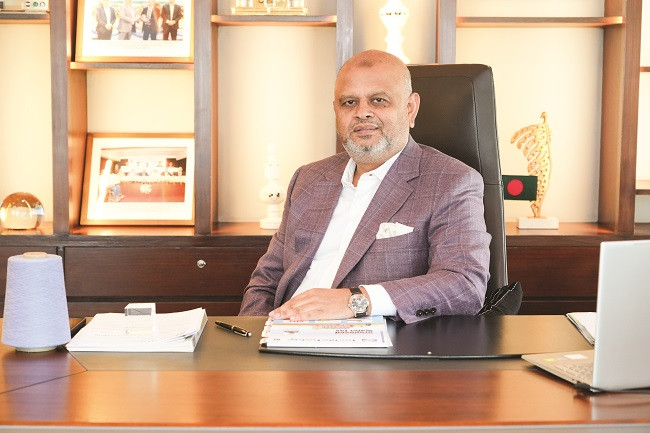
Textile Today: Kindly share Salma Group’s Journey.
Chowdhury Mohammed Hanif Shoeb: While Salma Group officially commenced operations in 1998, its roots in Bangladesh’s textile business extend back 70 years, a testament to the pioneering spirit of our family, particularly my father’s influential contributions to the industry.
As for our next growth focus, over the past four to five years, Salma Group has significantly diversified its production, shifting approximately 70% of its output to innovative, manmade fiber (MMF), blended, and specialized yarns, and a notable transition from its previous focus on cotton products. We have started a new factory with 22 tons of dyeing and all other necessary capacity. We are doing high-demand cotton mélange, flex fiber yarn.
Crucially, the human element behind the machinery is paramount for innovative products. This understanding drives Salma Group’s strategy of actively seeking out and recruiting brilliant, innovative minds. These individuals are leading our research and development (R&D) efforts, aiming for excellence in manmade fiber and other high-end blended yarns.
Textile Today: What is your view on the exploitation of bonded warehouse facilities, the Indian yarn import ban, and their impact on Bangladesh’s spinning mills?
Chowdhury Mohammed Hanif Shoeb: While the duty-free yarn facility via bonded warehouses is essential for the forward apparel sector, its misuse for illicit purposes severely harms the country’s backward linkage textile spinning industry. A destructive practice observed is the repeated misdeclaration of yarn counts—for instance, declaring 60-count yarn as 30-count—with such discrepancies occurring multiple times within a single shipment and LC. So, halting the Indian yarn import through land ports will certainly yield benefits.
The yarn imported by apparel owners often comes at prices unmatchable by local mills, primarily because the Indian government provides extensive benefits to its spinners, effectively lowering their production costs below ours. To counter this, our government must impose tariffs on Indian yarn to safeguard Bangladesh’s domestic textile spinning sector. Or the $22 billion investment spinning sector parish.
Textile Today: How can the spinning industry benefit from the central bonded warehouse facility for storing imported cotton in terms of reducing costs and lead time?
Chowdhury Mohammed Hanif Shoeb: Our current supply chain for cotton is severely protracted: opening an LC today means cotton arrives in 3 to 6-7 months, extending the full production cycle to 9-10 months. Meaning our banking and operational costs – with a long duration heavy inventory – are spiraling out.
However, with a central bonded warehouse facility, we could receive materials in just 5-7 days and complete deliveries within a month. This drastic reduction in lead time would significantly lower our credit requirements, accelerate revenue generation, and ensure timely bank repayments.
Textile Today: What kind of support do Bangladeshi spinners currently need from the banking sector?
Chowdhury Mohammed Hanif Shoeb: Spinning mills, being a highly capital-intensive industry, critically depend on robust support from the banking sector. Unfortunately, local banks often act merely as lenders, which is a misguided approach. Instead, they should function as true partners in the success of these mills. Given the long production cycle, banks should extend payment schedules to at least 10 months. This adjustment acknowledges the industry’s operational realities and would allow mills to repay dues promptly and sustainably, rather than facing undue pressure.
Textile Today: Given the reciprocal tariff policy of the United States, what difficulties do you predict for the spinning industry?
Chowdhury Mohammed Hanif Shoeb: The higher U.S. tariffs could reduce the competitiveness of our products in the U.S. market, which remains one of the largest export destinations for our industry. To survive, we must prioritize extensive market diversification, moving beyond our primary export destinations like the USA and EU to explore the abundant opportunities in new markets.
Textile Today: Salma Group’s JUTCO Fibre has stunned the market. Kindly share its prospects.
Chowdhury Mohammed Hanif Shoeb: JUTCO Fibre is a cottonized bast fiber that is modified from jute to use in the fabric manufacturing process (knit and woven). Its hand feel is close to linen and better than hemp. This newly innovated fiber, developed by Salma Group, emerged from a simple inspiration: if cellulose fibers like linen, viscose, or hemp can blend with cotton, why not jute? This inspiration led to a significant development in the textile world.
Our team undertook extensive research and development to achieve this breakthrough. Major international buyers like H&M and Inditex are impressed with JUTCO products. Given that jute is a native product of Bangladesh, integrating it into our export basket is a clear imperative.
Textile Today: With a growing demand for man-made fibers, how can Bangladeshi spinners tap into this emerging market?
Chowdhury Mohammed Hanif Shoeb: The global textile market is shifting, with demand for MMFs like polyester, viscose, and modal rising rapidly. To tap into this emerging market, I believe we need to take several strategic steps:
- invest in technology & machinery: Spinning man-made fibers requires specialized machinery and process control systems.
- Skill development: MMF processing involves different technical expertise compared to cotton.
In terms of our commitment to diversified yarn, Salma Group’s concern, Humaira Composite Textile Mills Ltd., is a blend of innovation by combining cutting-edge technology and responsibility. Our advanced fiber dyeing process is designed not only for efficiency but also for sustainability. Compared to traditional fabric dyeing, we save approximately 40% of water and reduce dye and chemical usage by 85%, ensuring an eco-friendly approach to creating fashionable and sustainable garments.

